

Biophilic
Oasis.
A 5-room HDB resale re-planned around openness, natural light, and a more connected way of living.
The people before the plan.
The homeowners—a professional couple—wanted a home that could adapt seamlessly to both quiet working days and hosting guests.
The existing 5-room layout provided enough floor area, but it completely compartmentalized the kitchen, living area, and study into isolated boxes. They disliked how cooking felt entirely detached from social activity, and how working from home felt confining rather than comfortable.
The brief was not to request a specific visual style. It was a request to fundamentally change how the spaces interacted with one another.
Solving within reality.
Design is easier when there are no constraints. Real interior design is solving within them.
- Structural Boundaries The RC beam separating the original kitchen and living area could not be altered, dictating the maximum opening height.
- Levels & Services Opening the kitchen meant adjusting its floor level to meet the living floor, and routing plumbing, gas and air-conditioning pipework around the new layout.
- Plumbing Points Existing yard plumbing restricted any major relocation of the laundry functions.
- Window Placements Natural light sources had to dictate where the primary living zones were anchored.
This was not simply an open-plan exercise. An open plan had to coexist with structure, levels, services, fabrication and construction.
How can the home become more connected without becoming undefined?
Start with what is already there.
Before changing the interior, I look at what the existing plan is actually doing. The issue was how the boundaries affected movement. Selected walls were removed, the structural beam was kept, and the boundary between functions was replaced by ceiling, joinery and furniture.
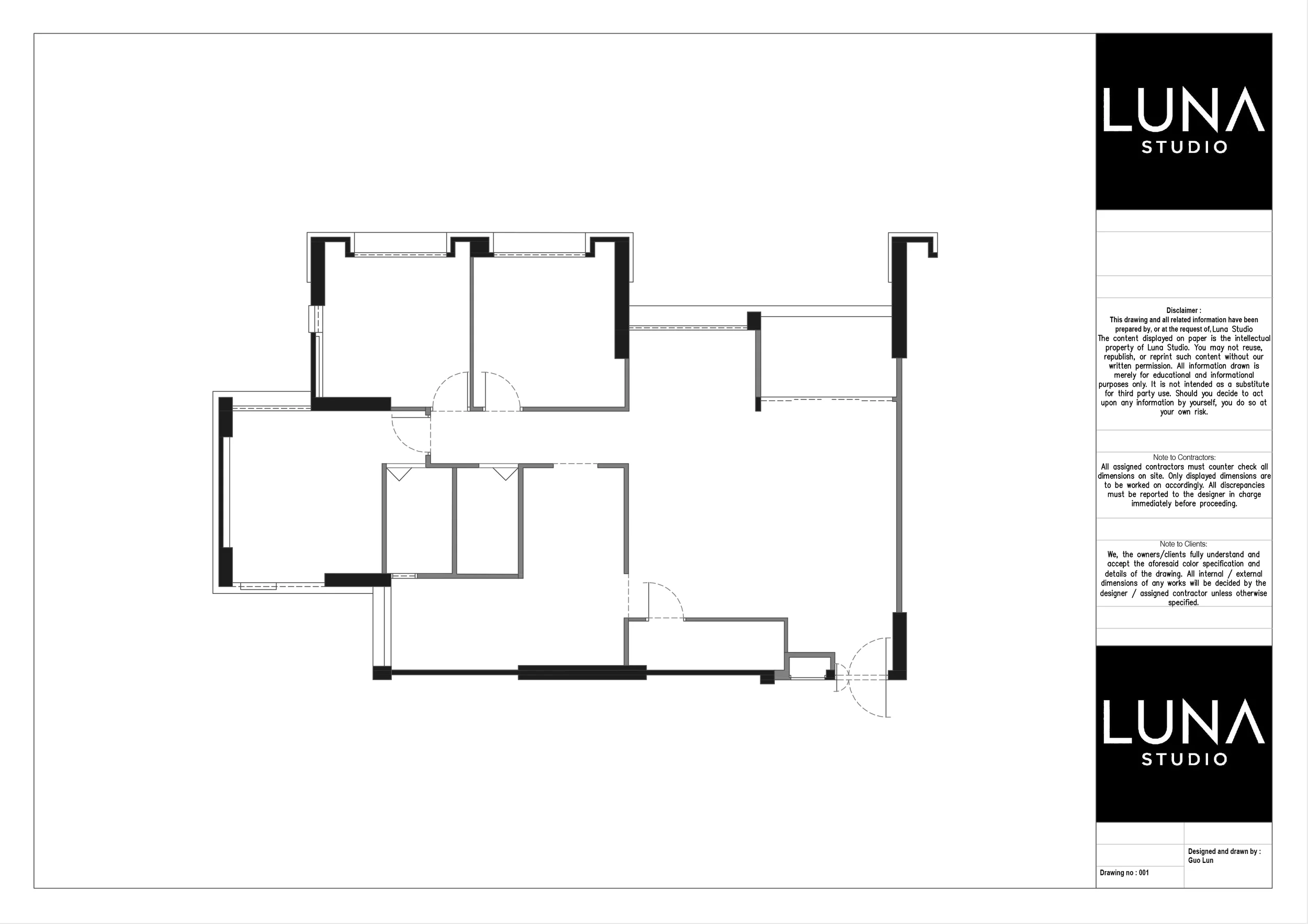
Existing plan — the kitchen, living area and study each sit behind their own boundary, isolating cooking and working from shared living.
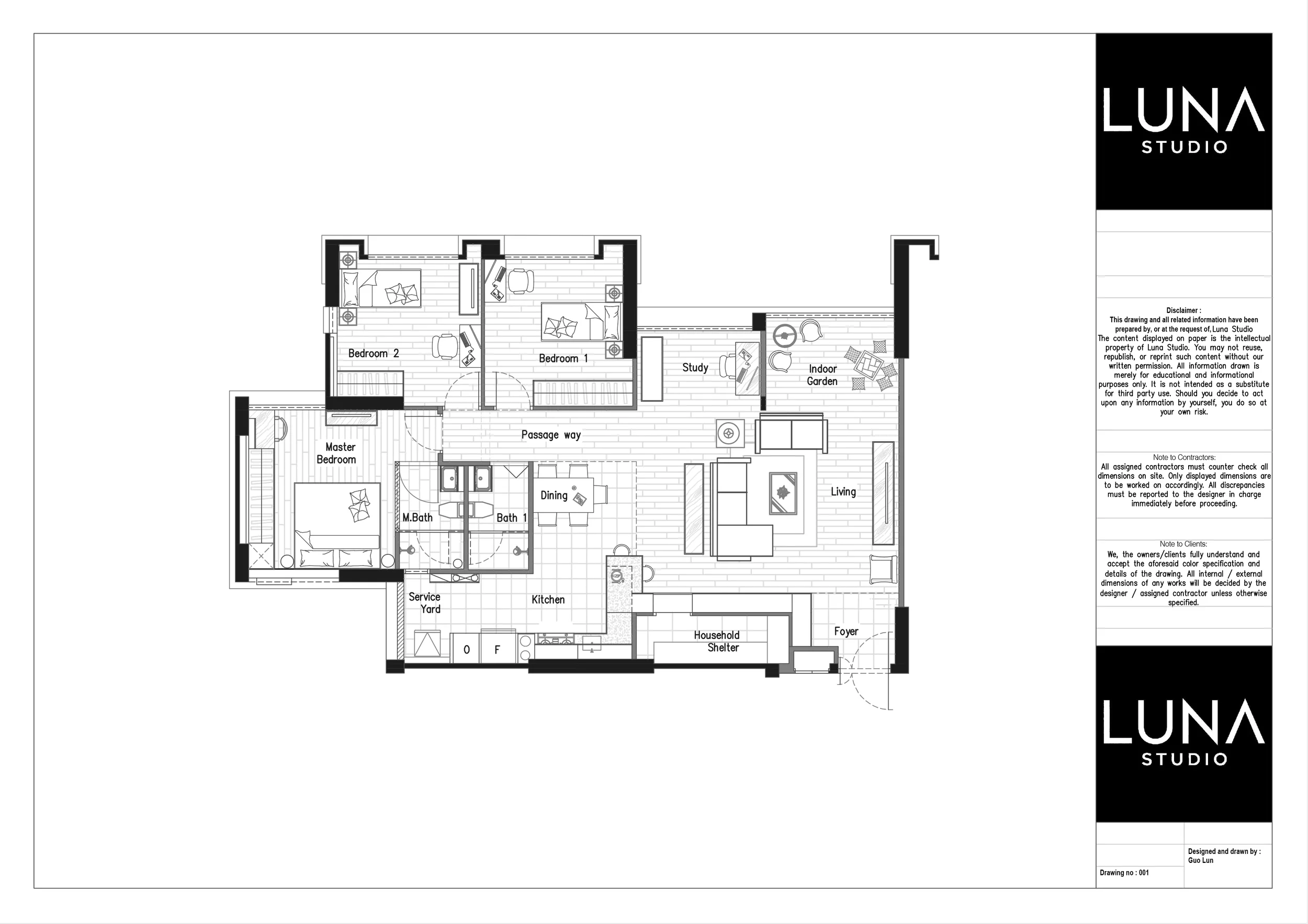
Proposed plan — selected walls removed, the RC beam retained, and kitchen, study and living connected. Architectural and joinery elements define each function without relying entirely on solid walls.
Here are the four moves that transformed the plan. Each is proven in the sections that follow.
01 Kitchen Opening
Opened towards the living area so cooking stays visually connected to everyday activity.
02 Study Zone
Integrated into the larger living space so working does not feel isolating.
03 Master Suite
Internal boundaries adjusted so bedroom, wardrobe and ensuite relate visually while staying separate.
04 Living Connection
Walls reduced to create longer sightlines, making the shared area feel considerably larger.

Solid timber at the window edge lets a boundary become a place to sit.
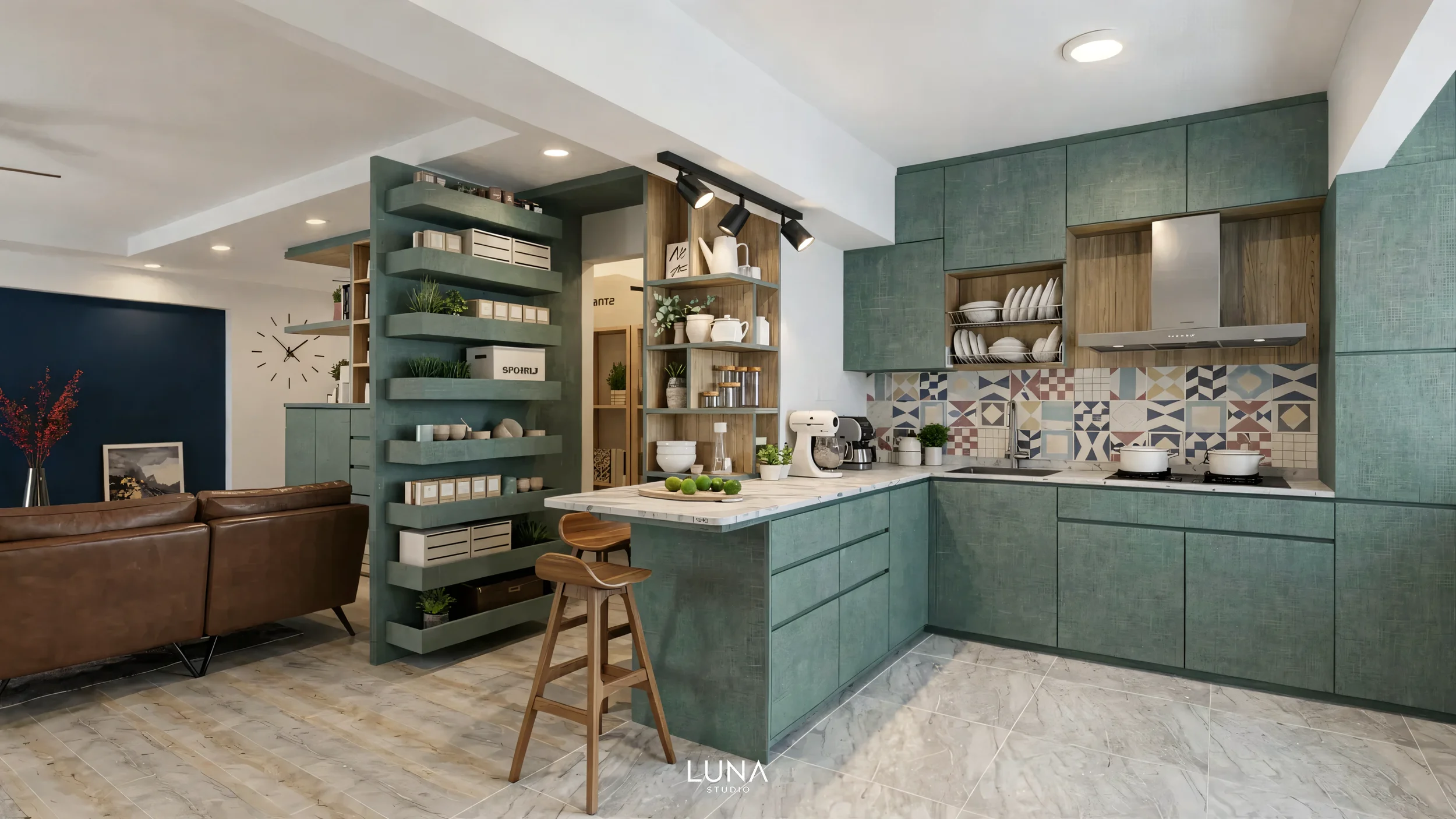
The peninsula marks the transition between cooking and shared living, avoiding the need for a physical wall.
Letting the kitchen participate.
The original entrance was opened entirely up to the structural RC beam, changing how the kitchen relates to the rest of the home.
A peninsula was introduced as the transition point between the two zones. Instead of reading only as cabinetry, it acts as a functional threshold. The opening was not a purely visual intervention: the island, floor transition, plumbing, gas connection, appliance housing and cabinetry had to be resolved as one coordinated system.
An open kitchen still needs a boundary. Here, that boundary is created by furniture and spatial placement rather than enclosure.

The teal cabinetry and patterned tile create a distinct yet cohesive functional zone within the open plan.
A workspace without walls.
A traditional enclosed study would have contradicted the wish for connection, so the response was to work with the openness instead of building a room.
- Ceiling Definition A 600mm-deep L-box ceiling establishes a clear overhead boundary for the zone.
- Joinery Function Full-height storage anchors the study, giving it the practical utility of a real office.
- Visual Connection The open sightline allows the occupant to work without feeling cut off from the home.

The study-lounge remains part of the larger living environment, allowing natural light to travel uninterrupted across the footprint.

Full-height joinery gives the study its function.

The working point, kept inside the shared room.
Function can be defined without enclosure. The ceiling provides definition, the joinery provides function, and the sightline provides connection.

A frameless glass partition separates the ensuite physically while maintaining visual continuity from the bed.
Balancing privacy and scale.
The goal was a greater sense of space between bedroom, wardrobe and ensuite, without leaving the bathroom exposed. Three options were weighed.
Option A — Maximum Enclosure
A solid partition gives maximum privacy, but rebuilds the visual enclosure the project was trying to reduce.
Option B — Maximum Openness
Fully open gives maximum space, but the bathroom loses the separation it requires.
Resolution — Controlled Permeability
Frameless glass keeps the ensuite practically enclosed while letting the suite read continuously.

The full-height custom wardrobe forms one continuous, quiet element along the room, hiding clutter.

Project material board — timber, textured surfaces, earthy colour and tile repeated to unify the spaces.
Restraint creates continuity.
Once kitchen, study and master suite were resolved, the palette was kept deliberately narrow so the open plan reads as one home rather than separately decorated spaces.
- Oak-toned Joinery Introduces warmth across the open plan, balancing the natural light.
- Darker Elements Establish visual depth and anchor the composition in key areas.
- Textured Surfaces Prevent the restrained palette from feeling flat.
- Ceramic Tile Introduces a smaller-scale rhythm where closer physical interaction is expected.
The materials are repeated intentionally, so the architecture stays coherent even as functions change.
Nature as Part of the Interior
Daylight and planting are treated as spatial elements, not decoration added after the layout was resolved.

Darker wall tones and natural greenery interact directly with incoming daylight.

Floating timber shelves carry planting up the wall.

Living continuity — a walnut sideboard repeats the timber tone of the joinery.

Joinery detail — chevron-laid timber adds pattern where the eye comes close.
Precision at close range.
Details are shown only where they carry the argument: timber repeated across furniture and joinery, and pattern reserved for the points of closest contact.
Luna Studio's Role.
As a founder-led practice, I am personally responsible for the continuity of the project. That is why the design story can continue into construction. For Biophilic Oasis, Luna Studio's scope included:
Space Planning
Identifying structural constraints and reorganizing the floor plan for maximum flow.
Interior Design
Developing the material language and biophilic concept alongside the clients' requirements.
Technical Documentation
Converting design intent into buildable joinery and layout elevations.
Renovation Coordination
Reviewing quotations and liaising during the construction phase to protect the design.
Design has to become specific.
The drawings exist to coordinate relationships that cannot be left to site interpretation: appliance dimensions, joinery divisions, service routes, ceiling conditions, material junctions and clearances.
The elevations below show how the kitchen, living room and master wardrobe were resolved before work began on site. The chain runs from decision, to specification, to fabrication, to installation.

Kitchen Elevation — resolving appliance housing and cabinetry divisions before fabrication.
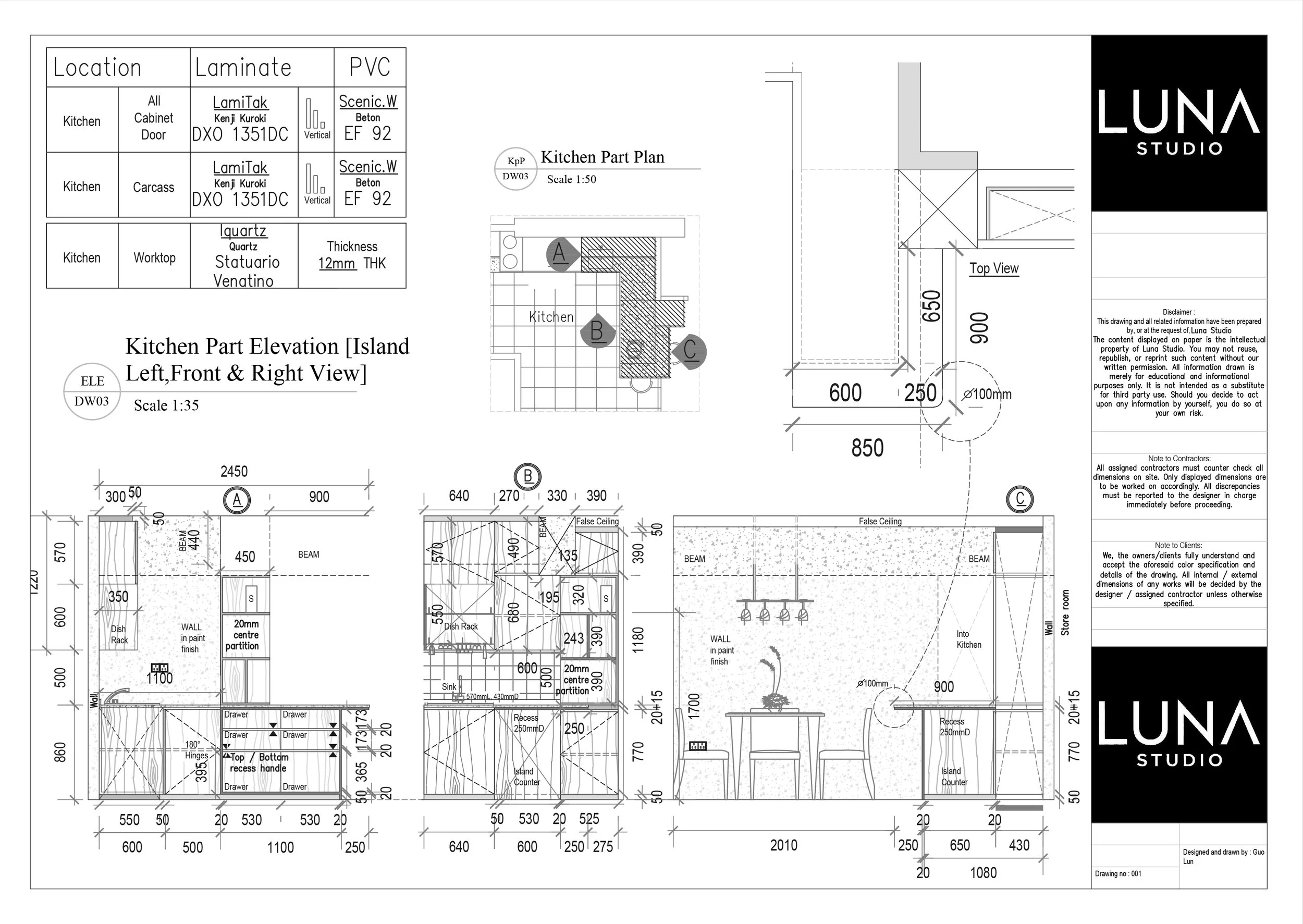
Island Elevation — establishing the exact height and relationship to surrounding architecture.

Living Elevation — storage integrated as a precise architectural backdrop.

Wardrobe (External) — continuous panelling hides functional clutter.

Wardrobe (Internal) — configured directly around the clients' habits.
When the design met the site.
The design was not finished when the drawings were approved. It kept making decisions as the physical project evolved.
The Open Kitchen
Wall and floor demolition, a floor-level adjustment to meet the living area, waterproofing, island plumbing, gas-pipe relocation and appliance housing all had to be sequenced around one opening.
The Glass Ensuite
Wall demolition, waterproofing, tiling, the glass partition and shower screen, and plumbing had to be coordinated so the partition could stay frameless and clean.
Scope That Evolved
Storage, wardrobes, service-yard elements, air-conditioning pipe boxing, windows, tiles and glazing were refined through variation works after construction began.
A Sequence, Not a List
Hacking, electrical, tiling, carpentry fabrication, ceiling box-up, plumbing, glass, installation, touch-up and handover depend on each other and cannot run independently.

Master bathroom — grey stone and timber keep it consistent with the suite's palette.

Physical detail — fittings set against geometric tile.
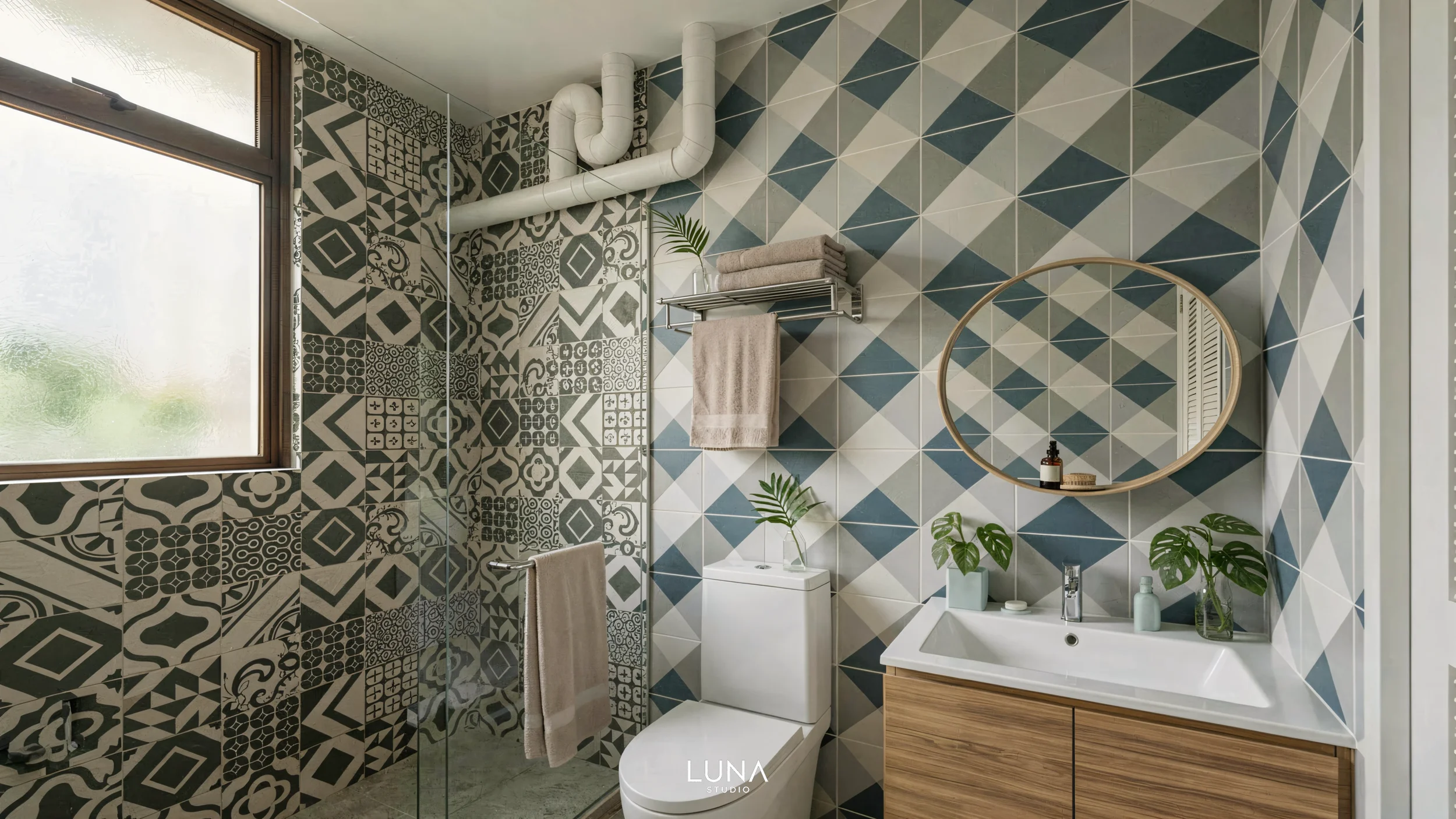
Bathroom — a geometric tile shifts the material scale for a more intimate zone.

Utility — a stacked washer within the enclosed balcony maximises the functional footprint.
Did they get what they asked for?
The brief asked for a home that adapts to quiet working days and to hosting, and for spaces that interact differently. The result answers each point.
- Working and Hosting One home now accommodates both, without separate rooms for each.
- Cooking Is No Longer Detached The kitchen anchors daily living rather than sitting behind a wall.
- Working Is No Longer Confining The study serves its purpose while the occupant stays part of the household.
- Spaces Interact Differently Sightlines are no longer blocked by unnecessary walls, so the home feels physically larger.
Read what clients say in their own words.
Independent reviews from Luna Studio clients, unedited.
Serene Botanica
5-Room HDB Resale · Bukit Batok WestA more extensive spatial reconfiguration focused on opening the home and improving the flow between spaces.
View Project →A Symphony of Warmth
5-Room BTO · Mt VernonA warm timber-led BTO where the study, kitchen and living areas were designed as connected functions.
View Project →Walnut Sanctum
4-Room BTO · Alkaff CrescentA study in contrast, using dark timber against lighter surfaces to create depth within a compact footprint.
View Project →
Not sure what should change first?
Start with the problem you need solved. Where is your renovation right now?